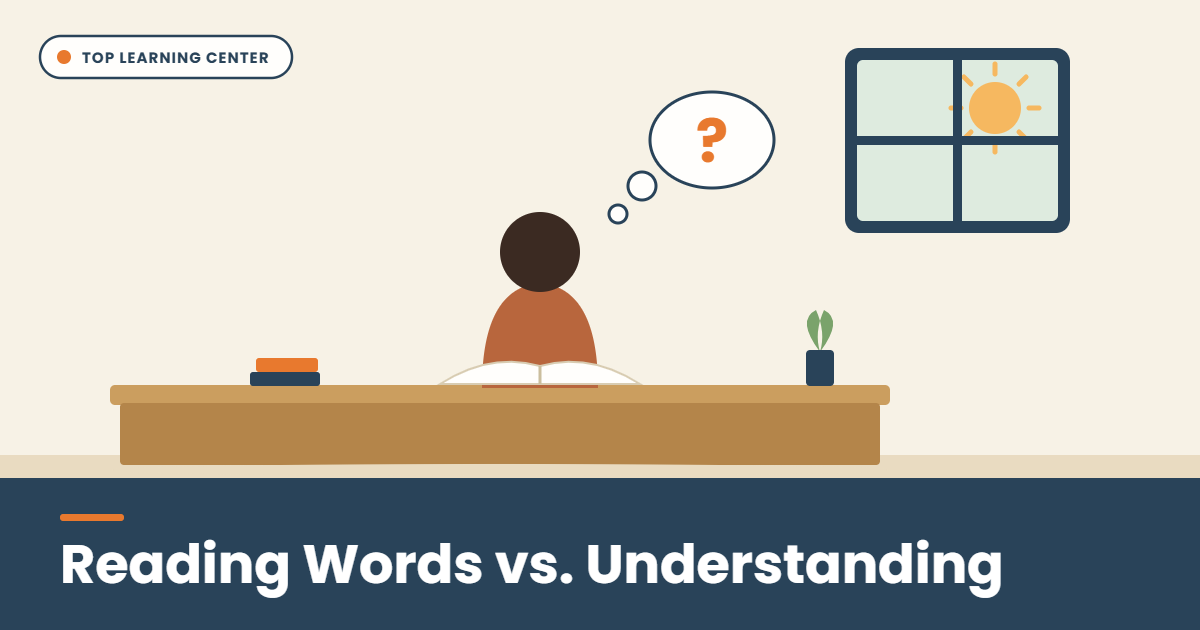
Some children can read a passage aloud smoothly but still have difficulty explaining what they just read.
This can be confusing for parents. If a child can pronounce the words correctly and finish the page without much difficulty, shouldn’t that mean they understand it?
Not always.
Reading the words and understanding the meaning are related, but they are not exactly the same skill.
1. Reading Fluently Doesn’t Always Mean Understanding
A child may be able to read every sentence correctly but still have trouble identifying the main idea, explaining what happened, or remembering important details.
After reading a passage, you might ask:
“What was that mostly about?”
and hear:
“I don’t know.”
Or the child may remember one small detail but miss the larger meaning of the passage.
This can be a sign that the student needs more support with comprehension rather than simply more practice reading the words aloud.
2. Vocabulary Can Get in the Way
Sometimes the difficulty isn’t the passage itself. It is the meaning of key words within it.
A student may be able to pronounce an unfamiliar word correctly without understanding what the word means.
If several important words are unclear, understanding the whole paragraph becomes much harder.
Building vocabulary therefore supports more than word knowledge. It can also help students make better sense of what they read.
3. Some Students Focus So Much on Reading the Words That Meaning Gets Lost
For some children, reading still requires a great deal of effort.
They may spend so much attention sounding out words, reading accurately, or getting through each sentence that they have less attention available for understanding how the ideas fit together.
By the time they reach the end of a paragraph, they may have forgotten what happened at the beginning.
In this situation, the issue may involve both reading fluency and comprehension.
4. Understanding Requires Connecting Ideas
Good comprehension involves more than remembering individual sentences.
Students need to connect information across a passage.
They may need to understand:
- who or what the passage is mainly about
- what happened and why
- how one event relates to another
- which details are important
- what the author is trying to explain
- what can be inferred even when it is not stated directly
A student may understand each sentence separately but still have difficulty putting those ideas together.
5. Retelling Can Reveal More Than “Did You Understand?”
If you ask a child, “Did you understand it?” the answer will often be “yes.”
A more useful approach can be to ask the child to explain the passage in their own words.
For example:
- What was the most important idea?
- What happened first, next, and last?
- Why did the character do that?
- What did you learn from this paragraph?
- Which part of the passage helped you answer that question?
These questions help show whether the child is actively making meaning from the text rather than simply finishing the reading.
6. Reading Comprehension Can Affect Other Subjects Too
Reading comprehension isn’t limited to language arts.
Students use reading to understand:
- math word problems
- science directions and explanations
- social studies passages
- written project instructions
- test questions
A student who has difficulty understanding written information may therefore experience challenges in several subjects even when reading itself appears fluent.
What Can Parents Look For?
Instead of looking only at how quickly or smoothly your child reads, pay attention to what happens after the reading.
Ask:
- Can my child explain the main idea?
- Can they retell important information in their own words?
- Can they explain why something happened?
- Can they connect information from different parts of the passage?
- Can they answer a question and show where the answer came from?
- Do unfamiliar words frequently interfere with understanding?
Patterns in these areas can help identify what kind of reading support may be useful.
Reading Support for K–8 Students in Glendale
At Top Learning Center in Glendale, reading comprehension is part of our academic support for K–8 students.
We help students work on understanding what they read, identifying important information, building vocabulary, and becoming more independent when responding to reading assignments.
The goal is not simply to finish a passage. We want students to develop the habit of thinking about what the text means as they read.